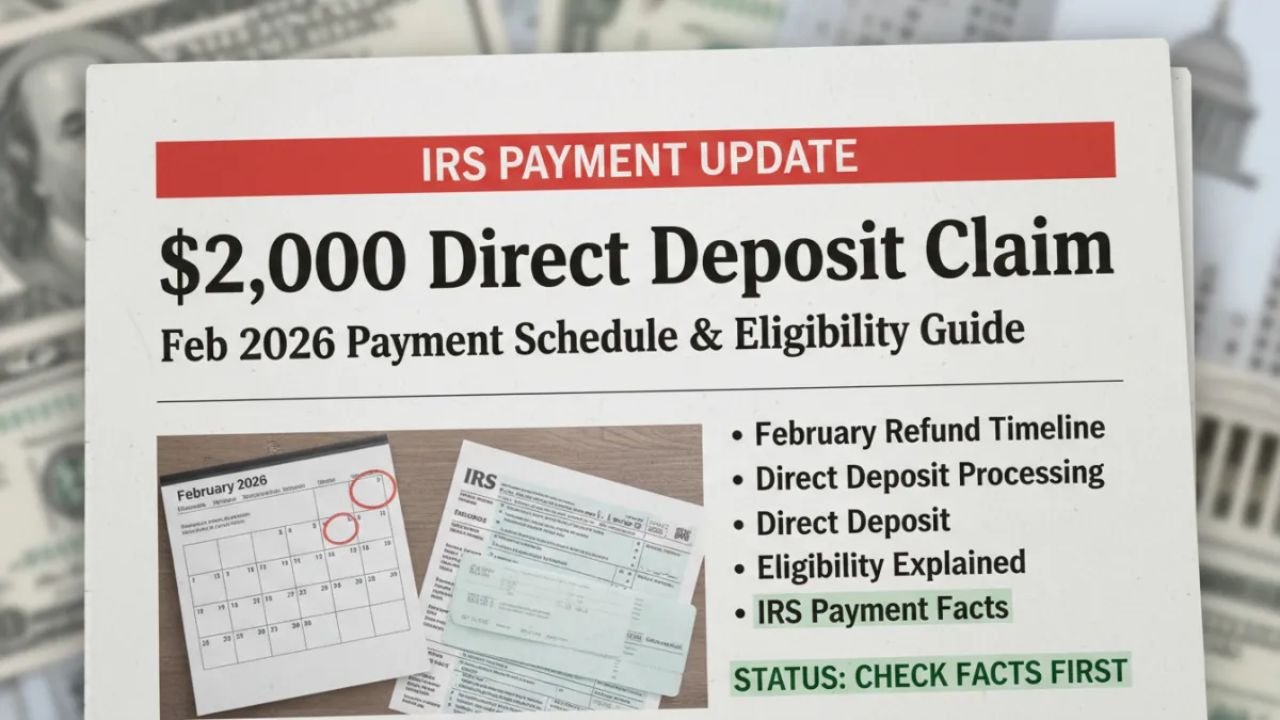
Rumors of a $2,000 IRS direct deposit for all U.S. taxpayers in February 2026 have been spreading rapidly across social media, WhatsApp groups, and short-video platforms. The claim is enticing, especially as households deal with post-holiday bills, rising grocery costs, and early-year expenses. However, no official announcement confirms a nationwide $2,000 payment, and the Internal Revenue Service (IRS) has issued no statement or guidance authorizing such a deposit.
Here’s a clear breakdown of what’s true, why the rumor spread, and how taxpayers can protect themselves from misinformation.
Why the $2,000 Payment Rumor Gained Traction

Financial rumors tend to spike during tax season for several reasons:
- Millions of taxpayers receive refunds around February, sometimes close to $2,000.
- Social media posts showing screenshots of deposits can be misinterpreted as a new government program.
- Algorithms amplify popular posts, making speculation seem legitimate.
Digital finance researcher Anita Menon explains: “People expect money to arrive, see others posting deposits, and assumptions quickly turn into viral rumors. It’s often not malicious, just misunderstanding.”
No Law, No Payment: How Federal Relief Works
In the U.S., federal payments require legislation. Agencies like the IRS cannot legally distribute money without a law passed by Congress and signed by the President.
Key Points About Federal Relief Programs
- Nationwide stimulus or relief checks are funded by legislation, not routine IRS operations.
- Past programs, like pandemic-era stimulus, were publicly debated, announced, and accompanied by official guidance.
- No such legislative or administrative signals exist for a $2,000 universal deposit in February 2026.

Without these legal steps, the viral claim remains unfounded.
Tax Refunds vs. Stimulus Payments
A major source of confusion comes from mixing tax refunds with stimulus checks:
| Type | Source | Purpose | Typical Timing |
|---|---|---|---|
| Tax Refund | Overpaid taxes during the year | Return of taxpayer’s own money | Early filers often see refunds in February |
| Stimulus Payment | Government relief funded by legislation | Economic support | Announced publicly, sent only after law approval |
A refund near $2,000 is normal for many taxpayers due to over-withholding or credits, but it is not a new IRS payment program.
Who Is Actually Receiving Deposits Now
- Early electronic filers see refunds first.
- Paper filings or complex credits take longer due to manual processing.
- Official IRS tracking tools are the only reliable source to confirm your refund status.

Financial advisers warn: screenshots or social media claims do not confirm any universal payment.
Why People Are Interested
The viral story reflects financial stress and expectations shaped by past relief programs:
- Inflation and cost-of-living pressures remain high in 2026.
- Many households recall previous stimulus payments and assume similar measures could return.
- Even the possibility of extra funds creates public excitement and engagement.
What to Expect in the Coming Months
Policy experts suggest that a universal $2,000 deposit is unlikely without a major economic downturn and legislative approval. Instead, any future relief is more likely to take the form of:
- Targeted tax credits
- Adjustments to existing benefits
- Emergency assistance for specific groups
For households, the safest approach is to plan budgets based on confirmed income, not speculation.
FAQs About the February 2026 $2,000 Deposit
1. Has the IRS announced a $2,000 direct deposit?
No. There is no official authorization for such a payment.
2. Can the IRS issue a payment without Congress?
No. Federal law requires legislative approval before any universal deposit.
3. Why do some refunds show up around $2,000?
Many taxpayers overpay through withholding or qualify for credits. Refunds reflect your own money, not new relief.
4. How can I track my refund safely?
Use the IRS “Where’s My Refund?” tool online or the official IRS mobile app.
5. Should I trust social media claims about IRS payments?
No. Only rely on verified IRS announcements or official federal communications.
Conclusion
The February 2026 $2,000 IRS direct deposit remains a myth. While refunds do arrive around this time, they represent overpaid taxes, not a new relief program. Taxpayers should avoid relying on social media claims and track their payments through official IRS tools.
Staying informed and cautious protects your finances, avoids scams, and ensures accurate expectations during tax season.